The state government is running a consultation on its ‘Review of the kangaroo harvesting plan.’ You can participate by going here.
The plan, and the program it describes, is justified by the following:
‘Areas with large kangaroo populations can experience issues such as:
- traffic accidents
- damage to pasture, crops, gardens and fences caused by kangaroos
- negative impact on vulnerable native vegetation or areas undergoing revegetation due to kangaroo grazing
- competition for grazing with livestock on farming properties
- kangaroos becoming aggressive towards people, usually when individual animals have regular contact with humans (e.g. become used to being fed by humans).’
According to the consultation documents, aerial surveys show between 2 million and three million kangaroos in the state.
These aerial surveys don’t include numbers for heavily forested areas, for obvious reasons. The numbers, density and abundance [of Eastern Greys] are significantly higher in the Central Region [of which we’re a part] than in other regions.
As witness recent correspondence in our local press, kangaroo shooting is controversial. A very quick look at the dot points above will reveal that a large part of the kangaroo problem relates to human behaviour: traffic accidents could be reduced if people drove more slowly; the practice of feeding kangaroos in the wild is silly, and should be massively discouraged; competition with livestock could be reduced if water points were less available to kangaroos; and better planning of urban expansion would reduce the impact on kangaroo habitat.
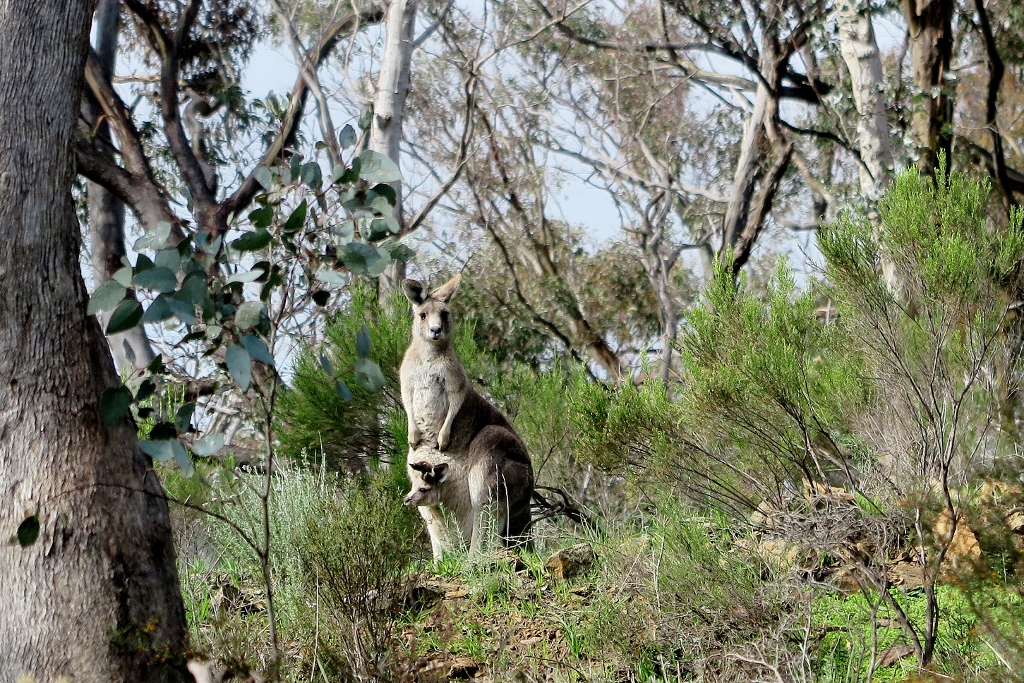
In the Castlemaine Botanical Gardens reserve: a clear appreciation of the facts about kangaroo populations is fundamental to any decision about management.
All of the above would require serious adjustments in our culture. And, as we know, our culture is not great at making adjustments to accommodate nature. The very idea of reducing speed limits, for example, sends Vicroads into nervous fits.
But there remains the third dot point: the effect of high kangaroo numbers on other animals.
What is the effect of kangaroo population density on grasslands, and therefore on the other creatures that live in them? Research in the ACT in 2014 argued that ‘There was a strong negative relationship between kangaroo density and grass structure after controlling for tree canopy cover… Changes in grazing intensity (i.e. grass structure) significantly affected reptile abundance, reptile species richness, reptile species diversity, and the occurrence of several ground-dwelling reptiles.’
The 2016 state government discussion paper Protecting Victoria’s Environment—Biodiversity 2036 provocatively claimed that ‘High numbers of kangaroos can exert high grazing pressure on native plants and wildflowers, a bit like rabbits, and can destroy habitat that ground-dwelling native animals may need to survive.’ It also pointed out that kangaroos had increased in numbers owing to ‘the increase in reliable water supplies (e.g. stock watering) and pasture for grazing’. That is, that human activity has altered the environment with the effect of making it capable of carrying larger numbers of kangaroos than would naturally occur. These larger numbers are not confined to agricultural areas, but spread to bushland where their grazing does significant damage to understorey, with consequent effects on biodiversity.
Changes to our culture, or intervention to control numbers—or both? Both present challenges.
For culling, the two obvious problems are rogue shooters, and cruelty.
Though cautiously endorsing kangaroo culling in some instances, the RSPCA has pointed out very serious failings in the current system, and has urged ‘that any measures taken to reduce kangaroo populations should first be proven to be necessary (through a proper consideration of the reasons for control). They must be conducted humanely and be under the direct supervision of the appropriate government authorities (as part of an approved kangaroo management program). Effective monitoring and auditing of such programs is vital to ensure that these conditions are met.’
‘Effective monitoring and auditing’ seems like a good policy at all levels of this debate. The key is in the word ‘effective.’
It’s significant that the reporting of the ACT research project on the Conversation website brought some objections criticising the validity of the research procedures, and therein lies another challenge: getting wide community consensus on what the facts are, based on the best science.
Interestingly, the 2016 Biodiversity paper also referred to increased human population as a problem for the environment, but did not pursue the theme…another contentious question on which considered, clear reflection and maybe some ‘auditing and monitoring’ might be revealing.
But one thing at a time. The consultation is open till July 11. Have a go.





 Click on image for info/order page
 Click on image for info/order page
 Click on image for info/order page